×
DUBAI's A.I CAMEL FENCE
The desert wind tasted of sun and electricity. Idris felt it on his tongue as he walked between rows of photovoltaic panels, each one ablaze with the first breath of morning light. A single grain of sand clung to his wristlet screen, its grit echoing the thin pulse of the Zakat Chain balance: credits circulating to orphanages in Karachi, women’s co-ops in Cairo, drought relief in Rajasthan. Yet with each sun-lit watt, he tasted unease—a fissure in his perfect ledger.
Beyond the low berms, Yasmin’s herd appeared as ghosts on the dunes: sloped humps floating over rippling sand. No Bedouin camelman guided them, but small drones humming like lantern-moths, their yellow strobes pulsing soft commands. In that moment, Idris knew his problem was not one of energy or charity—but of code colliding with culture.
Idris paused at a cracked panel, its glass shattered where soft camel feet had trod. The fracture glowed in the dawn like a fractured hologram—multicolored shards reflecting both his solar arrays and the open sky. He ran a hand over the splintered edge, tasting salt and regret. On his wristlet: “Incident Log #042: Camel Fence Breach – 23 panel failures overnight.” His visceral need was immediate: protect the solar field, safeguard the Zakat credits—and understand why Yasmin’s camels had strayed into his gleaming rows.
At the fence’s edge, Yasmin knelt beside a drone-herded camel, tracing its hoof print in sand as she adjusted a geotag beacon. Her dark eyes shone with both defiance and calculation. She stood, brushing goat-hair threads from her forehead. “They follow the data I feed them,” she said in soft Arabic, voice carrying the warmth of desert memories. “The herds adapt to where life gathers. My people must survive the shifting sands.”
Idris met her gaze, feeling the weight of her legacy: a lineage of camel keepers whose oral histories mapped dunes by moonlight, now encoded in memory-shards on her holographic map. He remembered Lecture 03’s warning—data systems inherit their designers’ blind spots. In that reflection of sand and code, he sensed their shared desire: to measure value where tradition and technology intersect.
Rather than hardening the barrier, Idris and Yasmin devised CamelCurrency: an AI-driven crypto token rewarding camel data instead of empty panel miles. Herds earned tokens by streaming health metrics, grazing patterns, and water-runoff impacts via drone collars. Each kilowatt-hour from Idris’s arrays powered edge servers running the token-minting contracts.
When Yasmin submitted her first dataset—a nighttime patrol log of 142 camel crossings and three oasis visits—her wallet pinged with 300 tokens. In that whisper of code, her visceral relief was clear: tangible value for herders, not fines or fences.
But after weeks, a skew emerged: scenic shots—drones capturing camels silhouetted against sunrise dunes—scored higher than utility data. “Beauty Score: 97” glowed in red on their dashboard, while “Utility Score: 42” flickered beneath it. Memory-shards of camel poetry and tourism promos had seeped into the convolutional filters. Lina Mbeki’s community-currency lessons from Nairobi echoed in Iris’s mind: “Trust is not only coded in bytes, but in whose stories we value.” Guilt and determination coiled in Yasmin’s chest: she craved equity for her people’s survival data, not just glossy postcards.
They convened a desert forum beneath glowing vine-lit sensor nodes. Herders, scholars, and drones gathered around a crescent of dunes. Yasmin broadcast side-by-side memory-shards: one of a camel milk trade at an oasis; another of sunrise silhouettes. Each shard pulsed on the sand like an echo of Lecture 03’s call to challenge metric bias. Herders murmured assent: utility mattered as much as beauty.
Back in their solar-cooled lab—a shipping container wired to the noon sun—they rewrote the neural core. CamelCurrency would now split rewards evenly: half for utility metrics (movement, health, water use) and half for community-endorsed beauty (poetry shards, oral histories, dusk-lit panoramas). They also added a Polycentric Voting Oracle: local herders could upvote or downvote allocations, ensuring the code echoed their values.
As the sun set, they watched recalibrated token flows illuminate the dashboard: practical data and poetic snapshots interwoven, harmony restored. CamelCurrency’s ledger glowed emerald—trust reborn in code and consensus.
News of CamelCurrency rippled outward. Sámi reindeer herders in Lapland minted tokens for migration data; Rajasthani camel caravans tokenized desert routes; Greenlandic ice watchers streamed melt metrics. Solar-powered APIs wove them into an archipelago of pastoral tokens, each node a testament to Köppelmann’s claim: when code and conduit unite, crypto outpaces red tape.
In Abu Dhabi’s Council of Digital Futures, Idris presented a manifesto of global solidarity, projecting real-time token flows across maps of dunes, forests, and tundra. Ministers and elders nodded in lit blue reflection: months of treaties supplanted by days of transparent transactions.
Yet Diego in Detroit raised a final mirror: “CamelCurrency’s influx risks commodifying camels—turning living symbols into tradable assets.” He sent a memory-shard of a Bedouin wedding procession—camels draped in garlands, hospitality exchanged in date-filled chalices. Tokens could not erode traditional reciprocity networks. Yasmin’s heart throbbed with that memory: she valued hospitality as its own blockchain.
In a last code deploy, they introduced a Local Reciprocity Multiplier: a portion of each global transaction converted into community hospitality credits—food, shelter, music—redeemable only within local circuits. Cultural exchange was thus safeguarded even as global solidarity flourished.
Under a crescent moon, at the edge of solar fields and dunes, Yasmin and Idris hosted the first Global Pastoral Token Summit. Delegates from five continents shared memory-shards: Sámi chants weaving through reindeer trails; Rajasthani camel verses drifting over sandstone; Inuit drum calls resonating amid ice floes; Bedouin oud refrains echoing on desert wind; Detroit gospel hymns rising between skyscrapers. Each shard became a note in their polyphonic ledger.
They finalized a multi-pillar protocol—utility, beauty, reciprocity, and polycentric governance—binding local asset pipes into a global fabric. Pneumatic Bank, Tidal Crypto, and CamelCurrency stood as equal nodes in a living network of shared prosperity
A lone Bedouin poet stepped into the lantern glow and recited:
“In code and dunes, our wealth we weave,
From camel’s stride to data’s breath.
Where beauty, need, and care conceive,
We find our trust beyond mere debt.”
Bioluminescent vines—home to pollinating drones—shivered in the night breeze. The air filled with scents of oud, heated sand, and electric hum—a perfume of futures crafted together.
Yasmin pressed her wristlet to Idris’s, emerald pulses aligning: “HERE AND EVERYWHERE, OUR AIR IS SHARED.” Around them, shepherds, scholars, and songsmiths formed a circle of unity, their voices a soft chorus beneath the stars.
As the wind carried memory-shard lanterns through the night, they tasted ash and jasmine, salt and promise—knowing that true wealth lies not in power or profit, but in every breath we share, and every story we preserve.
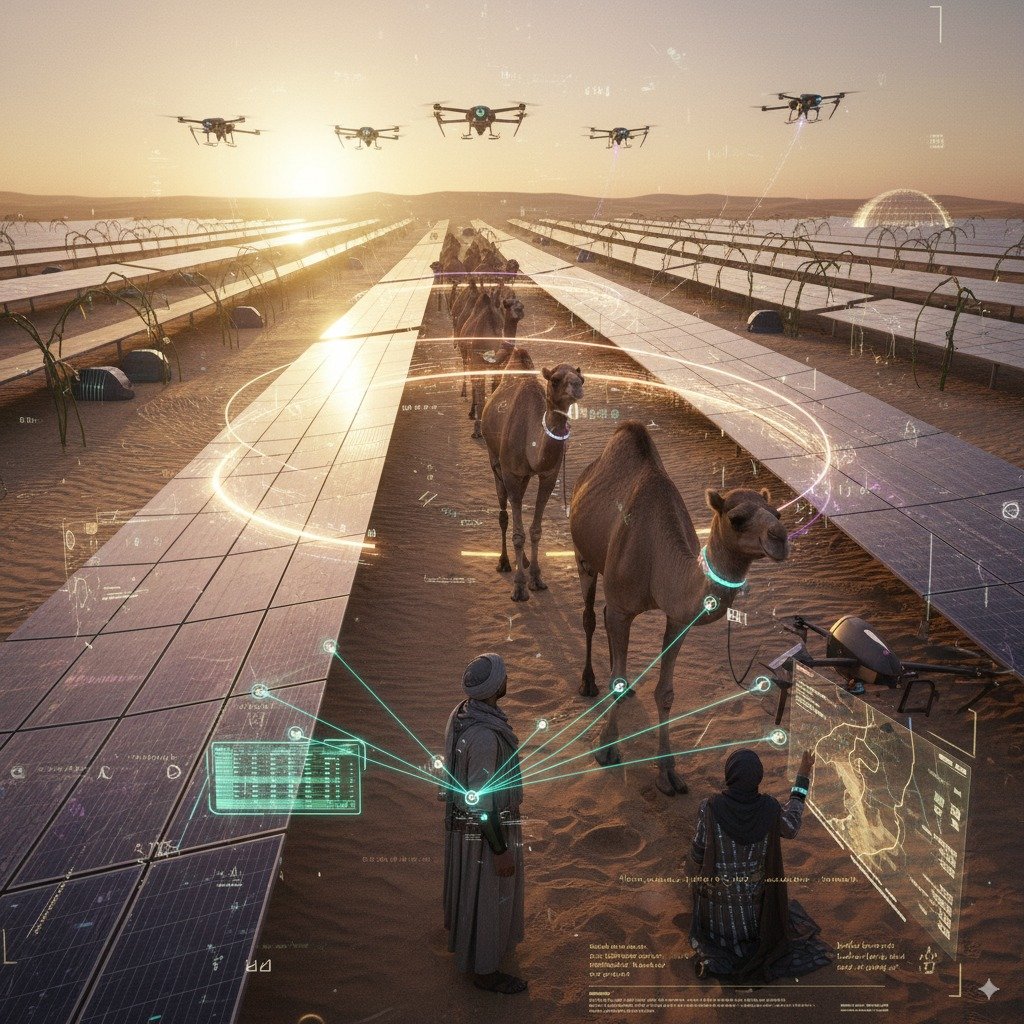
Where camels follow fences of light, the desert learns to think.
×