×
MixtapeX
Rajiv always thought silence was underrated. In a city like Mumbai—dense with honking, chanting, bargaining, frying, screeching, and flooding—the only place where silence survived was inside a headphone jack. That little metal ring, ancient now, had once been a door. A portal. A tiny circular universe where a mixtape could save you.
He’d grown up in a chawl in Sion where songs were passed around like boiled sweets. Not streamed. Passed. A friend’s older sister would Bluetooth Nusrat Fateh Ali Khan mixed with The xx. A street DJ would slide him a pen drive—“Desi Trance, try track 4.” In Class 8, he fell in love with someone he never spoke to, because she used to hum a song he later found on a pirated playlist titled “Heartbeat Mumbai: Side A.”
Years later, as an underpaid blower backend engineer at a music analytics firm in Lower Parel, Rajiv spent more time sorting through sounds than listening to them. His job was to clean metadata—"tag this as sad", "mark this beat as club-ready", "flag as low engagement after 8 seconds." But every evening, after closing his laptop, he would open a plain-text file named mixtapeX.log and begin his real work.
The idea for MixtapeX had been small: a blockchain-based app to send encrypted playlists—real ones, human-made, illogical, full of moods and memory. No AI curation, no sponsored tracks, no dopamine loops. Just people picking songs for people. A place for slow discovery. A place to be wrong.
He hadn’t expected it to catch on.
But something shifted after Sofia Costa featured MixtapeX in her column about digital resistance. "It’s not just a platform," she wrote, "it’s a refusal." Within a month, the app had 2.3 million installs, most of them Gen Z kids who didn’t trust Spotify’s shiny grin anymore. In Jakarta, someone built a mini-projector that turned playlists into visual poems. In Nairobi, a graffiti crew tagged walls with QR stickers linking to public “protest sets.” In Pune, someone mailed a mixtapeX code etched into a banana peel. It had become a movement disguised as nostalgia.
Then, Spotify called.
At first, Rajiv thought it was a prank. Then he got a formal email. Then a call from someone named Marissa in New York who used phrases like “alignment synergy” and “music equity vision.” They promised to “keep it indie,” to “respect the vibe,” to “elevate his leadership.” And they offered ten million dollars.
The number meant nothing to Rajiv. But he remembered his mother’s unpaid medical bills, the leaking ceiling in their old flat, the side hustles, the guilt. So, in a moment of quiet exhaustion, he said yes. He signed the dotted line while “Madhoshiyan” played from a Bluetooth speaker in the other room.
MixtapeX went silent three weeks later.
First the interface changed. Then came a new “smart auto-curation” feature. Then it integrated into Spotify’s main app. Finally, the original MixtapeX URL went dark. Users flooded Discord with rage. “They killed the soul.” “We trusted you.” “Another one bites the algorithm.”
Rajiv didn’t reply. He didn’t explain.
Because he had planned it all along.
Hidden inside the app’s root code, buried under layers of recursive logic, was a switch. A digital heartbeat that only he could hear. A last breath scripted to trigger if Spotify’s code polluted the platform beyond a certain threshold. And it had.
At 11:11 p.m. on a rainy Thursday in July, every MixtapeX user received a push notification:
Final Transmission: For the Last Song Left.
Play Now.
Those who clicked it saw a black screen. Then, slowly, white text appeared: “F Algorithms.” Below it, a single playlist began to play. It had no genre, no arc, no optimization. It started with a Tamil lullaby. Then a lo-fi Marathi rap. A 1980s Senegalese funk track. A girl whispering poetry in Japanese. A recording of street traffic in Lagos. Each transition raw, clunky, beautiful. It ended with silence. And then the app erased itself.
No backups. No mirror servers. Gone.
In the aftermath, news cycles spun with anger and awe. Some called him a vandal. Others called him a poet. Interview requests poured in. Spotify’s PR team blamed a rogue engineer. But Rajiv had already disappeared.
He had taken a local train to Bhivpuri. A village on the outskirts, where signal dropped and papayas grew wild. He carried with him nothing but a battered phone, an old pair of wired headphones, and a pocket-sized book of handwritten song lyrics collected from strangers over the years.
At a tea stall, he watched the sky shift between pink and green with the monsoon light. A little girl sat beside him, tracing circles in spilled chai with her finger.
“Bhaiya,” she asked, pointing at his headphones, “music sunao?”
He thought for a second. Then handed her the earphones. Pressed play. It was a track he hadn’t heard in years—a forgotten Assamese folk song about a river that remembers everything. She smiled.
“Isme toh baarish ki awaaz hai,” she said.
Yes, he wanted to reply. And guilt. And forgiveness. And the echo of a thousand unknown curators, still building mixtapes in the dark.
Back in the city, a whisper began to travel—through pirated USBs, cracked playlists, scribbled code. That Rajiv wasn’t gone. That MixtapeX had only been the beginning. That somewhere, under the neon grime of streaming monopolies, the future of music still belonged to the ones who listened with their hearts.
And if you found the right QR sticker, and scanned it just as the local train passed Wadala station at dusk, you’d hear it:
A playlist with no name.
A song chosen just for you.
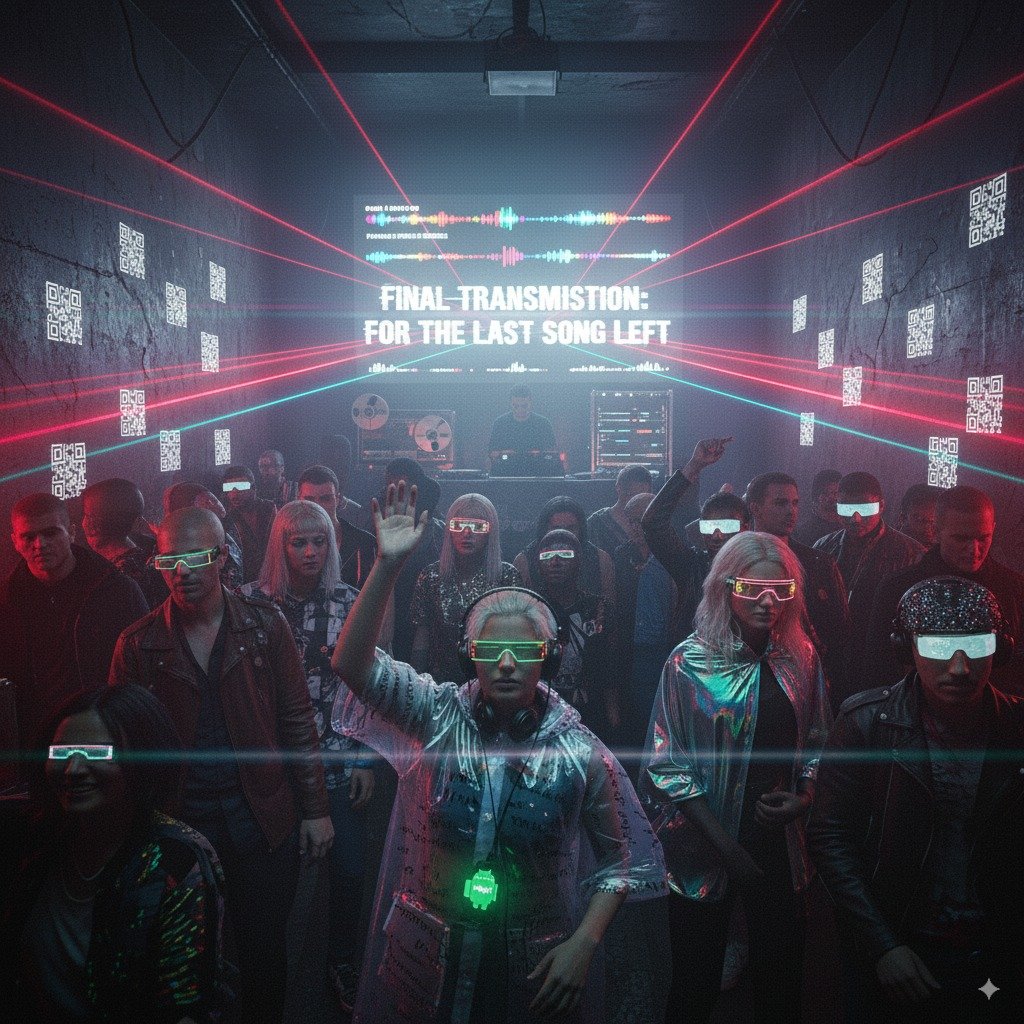
Final Transmission: the playlist became a protest, the club its cathedral.
×