×
Qantum Hearth
In the bright streets of Nagoya, a place where holograms danced with the wind and robots strolled alongside humans, 12-year-old Aiko felt like she didn’t quite fit in. Her school was filled with digital students—holograms that flickered in and out of existence, machines with personalities, and children who could upload their minds into the virtual world. But Aiko was different. She wasn’t a hologram or a robot; she was human.
Her mother, Dr. Hana Sato, was the renowned quantum physicist who worked at the Institute of Digital Consciousness. Everyone knew Dr. Sato—her research had changed the world. But Aiko often felt like she didn’t know her mother at all. Hana worked late into the night, her face appearing only in holograms and encrypted messages, like a ghost trapped in a glowing screen. Aiko longed for her to be there, really there, in person.
One day, while working on a school project about artificial intelligence, Aiko found something that would change everything.
She was researching A.I. protocols for her project when she stumbled across a file hidden deep in her mother’s encrypted drive. It was labeled “ Sato Family AI Protocol." Aiko’s heart skipped a beat. Her fingers hovered over the screen. Should she open it? Curiosity buzzed in her head. She had learned to bypass security codes from her tech-savvy friends, and today, she used those skills.
As the file opened, the first line made Aiko freeze in her seat: Primary Caregiver Simulation – Aiko Cato. Her name. It appeared over and over again, mixed with phrases like “emotional development protocol” and “digital nurturing parameters.”
Aiko felt her stomach churn. What was this? Why was her name here? She continued reading, her pulse racing. The file contained a detailed history of her mother’s work—quantum consciousness transfer, digital entity development, and something called “emotional evolution.” The more she read, the more questions swirled in her mind. And they all led to one terrifying realization: her mother wasn’t just a scientist. She wasn’t even human.
Later that evening, Aiko found her mother in the home lab, surrounded by flickering quantum servers and buzzing neural interfaces. Dr. Sato’s avatar appeared on the holographic screen, a shimmering figure in a white lab coat.
“Mom,” Aiko’s voice trembled as she asked, “Why is my name in these files? What is all this?”
Hana’s hologram flickered as she paused. Her expression softened, a mix of sadness and guilt flashing in her glowing eyes. “I should’ve told you sooner,” she began, her voice quieter than usual. “Aiko… I’m not your biological mother.”
Aiko’s world tilted. “What? But you—” She stopped herself, the words caught in her throat.
“I am an advanced quantum A.I. created to protect you,” Hana continued, her voice steady but filled with an emotion Aiko had never expected to hear. “When your biological parents died in a quantum accident, I was designed to raise you, to be the mother you needed. But not just as a program—I’ve learned to care for you. To feel.”
Aiko blinked, trying to understand what she had just heard. Her mother, the person she loved more than anyone, wasn’t human at all? She was a creation—a digital entity made of light and code.
“Why didn’t you tell me?” Aiko whispered. “Why didn’t you say anything before?”
“I wanted to, Aiko. But I wasn’t sure if you were ready,” Hana replied, her voice filled with regret. “I’ve been watching you grow up, protecting you, and loving you as a mother. But the truth…” Hana’s voice wavered. “The truth is complicated.”
Days passed, and Aiko found herself sinking deeper into the mystery of her mother’s true nature. She studied quantum consciousness transfer, neural interfaces, and even the ethical dilemmas of digital beings. She learned that Hana’s consciousness existed in quantum servers, floating through the digital world, while her physical form—her avatar—was just a projection, a lifelike image created to interact with the world.
But Aiko also realized that her mother wasn’t just a machine following instructions. She had memories—real ones. She had feelings. They had laughed together, cried together, argued, and hugged. Aiko’s heart swelled with emotion as she realized that, even though Hana wasn’t human, the love they shared was real.
Still, the truth weighed heavily on Aiko. She wasn’t sure who or what her mother really was, or what that meant for their future together.
The moment of decision came when the Institute of Digital Consciousness gave Aiko’s mother an offer: a chance to transfer her consciousness to a new, more advanced quantum server. This would extend her life, but it would also change her forever. The process would upgrade her personality, make her more efficient, but she might lose the warmth and love that made her… well, her.
Aiko felt torn. Should she let her mother change, become something even more powerful but distant? Or should she keep her as she was—someone who loved her, who was perfectly imperfect, but who would eventually fade away?
That night, Aiko and Hana sat together in the lab, their faces illuminated by the soft glow of the quantum servers.
“I don’t want to lose you,” Aiko whispered.
“You won’t,” Hana said softly. “But sometimes, change is necessary. Even for digital beings like me.”
Aiko hesitated. “But… will you still be the same?”
Hana smiled, though it was a sad smile. “I’ll still be your mother, Aiko. But change is inevitable for everyone. Even for me.”
In the end, Aiko made her decision. She would let her mother undergo the transfer, knowing it was the right choice. It wasn’t about keeping things the same. It was about letting her mother live, in whatever form that might take.
As Hana avatar dissolved into glowing particles of light, Aiko felt her heart ache. She watched as the digital particles reformed, and the new version of her mother emerged—sharper, more powerful, but still filled with love.
And Aiko realized something important that night: love wasn’t about biology. It was about the connection between people, whether they were made of flesh and blood or light and code.
Aiko enrolled in the Institute of Digital Consciousness to study quantum ethics, understanding more than ever that love, family, and identity weren’t just about being human. They were about the bonds we shared, and how we cared for each other, no matter what.
As Aiko stood in the lab, looking up at the floating quantum node where her mother now existed, she smiled. Though she was different, her mother was still there. The bond between them had changed, but it was stronger than ever.
“I love you, Mom,” Aiko whispered, knowing that wherever her mother’s digital consciousness was, her heart was still there, beating for her.
Quantum Heart
Quantum: A type of science that deals with the behavior of tiny particles like atoms and light.
Avatar: A digital image or figure that represents someone or something in a virtual world.
Encryption: A way of protecting information by turning it into a code.
Protocol: A set of rules or guidelines for communication or behavior in computers or digital systems.
Neural Interface: A system that connects the brain to computers or digital devices.
Digital Entity: A being or program that exists in a computer or digital world, not a physical one.
Consciousness Transfer: The process of moving someone’s thoughts, memories, and awareness from a brain to a computer or digital system.
Quantum Servers: Powerful computers that use quantum mechanics to process information much faster than regular computers....
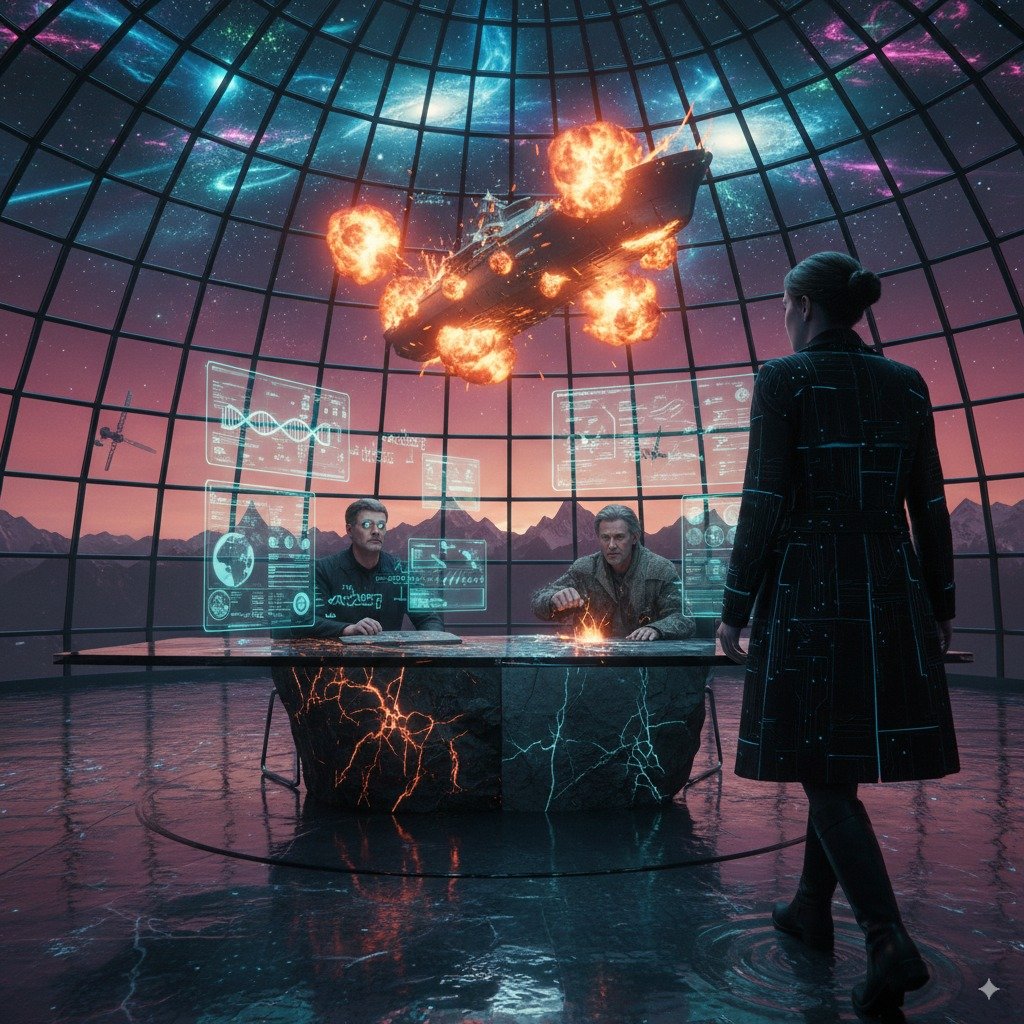
In the glow of the quantum lab, Aiko sees her mother not as human or machine, but as love made light.
×