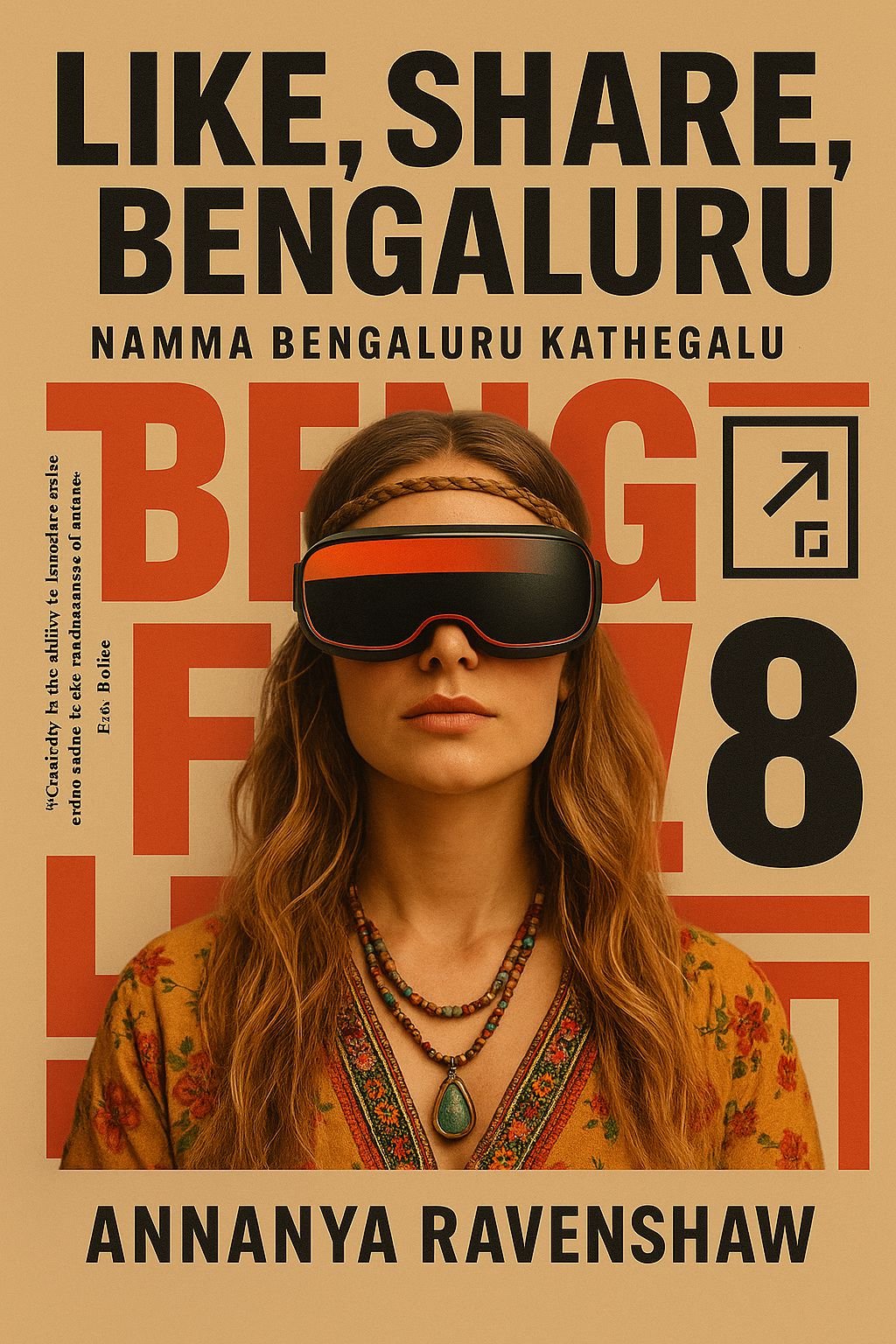
In a city where startups rise and fall in the time it takes to scroll, one viral moment can make or break destiny. Like, Share, Bengaluru captures the chaos, ambition, and heartbreak of India’s tech capital at the edge of an AI-driven tomorrow.
Bengaluru isn’t just a city. Iit’s a feed, an algorithm, a perpetual notification. In Like, Share, Bengaluru, the pulse of India’s Silicon Valley is reimagined as a place where memes spark revolutions, data brokers trade secrets like chai, and ambition bleeds into burnout. This is not science fiction set far away—it’s a mirror held up to the city you already know, amplified into the near future.
At its heart, the book follows the creators, coders, dreamers, and hustlers who live at the mercy of virality. A startup intern who becomes an overnight sensation. A streetwear designer who hacks algorithms to push local culture global. An AI that learns too much from the city’s chatter. Their stories collide in a Bengaluru that feels both familiar and disorientingly new—where your next like, share, or swipe can alter more than just your screen.
But this isn’t a simple love letter to tech. Like, Share, Bengaluru digs deep into the emotional cost of constant connection—how friendships warp in the glow of engagement metrics, how family bonds strain under the pressure of global competition, how identity becomes both branded and blurred. In a landscape where every idea is monetized, what does authenticity even mean?
For readers of near-future fiction, Indian urban drama, and anyone obsessed with the intersection of culture and code, this book delivers urgency, humor, and heartbreak in equal measure. It is not just a story—it is an experience, one that lingers long after the page is closed, whispering that the city’s greatest revolution might not come from boardrooms or politicians, but from the people who live and scroll there every day.
Through the Lens of Readers
4.5
Adithya Narayan - Indiranagar
4.0
Meghana Shetty - Jayanagar
4.0
Rohit Varadarajan - Whitefield
4.0
Divya Prakash - HSR Layout
From the Future
Author
A. Ravenshaw
Annanya Ravenshaw’s career has always been shaped by curiosity. For over a decade, she worked as a Montessori teacher, nurturing children’s natural sense of wonder and independence. Her fascination with how people learn eventually drew her into the world of artificial intelligence, where she became a researcher focused on machine learning. Joining a stealth-mode AI start-up gave her a front-row seat to the excitement and turbulence of building technology at the edge of possibility.
When the start-up came to an end, Annanya chose to follow the passion that had always been waiting quietly in the background: writing. Her books bring together the patience of a teacher, the analytical lens of a researcher, and the imagination of a storyteller. She writes to explore how humans adapt — to new ideas, new technologies, and new ways of seeing the world.
Read Free
Included with Kindle Unlimited. Start reading Zeroverse today at no extra cost with your subscription.
Varun stood by the balcony of his Ulsoor high-rise, looking down at a world that suddenly seemed grainier. A few cars moved sluggishly. The sound of a vendor's cycle bell rang from somewhere far below—bright, analog, obnoxiously real. He had lived in this apartment for eleven months and hadn’t once walked down his own lane without GPS.
Read it free today, or own it forever — either way, you win.
The first thing Varun noticed was the silence. Not the soft, meditative kind that comes with early morning light filtering through curtains. This was the wrong silence. The one that happens when the fridge stops humming, when the ceiling fan slows mid-whirr, when your phone refuses to load even a weather update. His AC had shut off in the middle of the night, and now the air hung around his face like hot laundry steam. A sour memory of last night’s Old Monk clung to his tongue.
He grabbed his phone. No notifications. No red badge on the food delivery app. No green dot on WhatsApp. His screen was a still lake—no ripples, no pings, no dopamine drip. He rubbed his eyes. Tried again. Same result.
He was thirty minutes into his weekend and already ravenous. The fridge, predictably, had only almond milk, two sachets of ketchup, and a piece of cake he didn’t remember ordering. Hangover pangs screamed for dosa. Crisp, golden, overflowing with masala and served with that watery hotel-style chutney. He opened his food app again. Error 503.
A strange nervousness bloomed in his chest. Like being locked out of his own body.
The outage wasn’t just his. Within a few scroll-less minutes, it became clear: no cab apps, no UPI, no Google Maps. Some sort of citywide glitch—or hack, maybe. Twitter, too, was eerily quiet. For the first time in years, the city felt like it had collectively held its breath.
Varun stood by the balcony of his Ulsoor high-rise, looking down at a world that suddenly seemed grainier. A few cars moved sluggishly. The sound of a vendor's cycle bell rang from somewhere far below—bright, analog, obnoxiously real. He had lived in this apartment for eleven months and hadn’t once walked down his own lane without GPS.
Still, hunger was a persuasive thing. By 10:45 a.m., shirt slightly crumpled, wallet reluctantly retrieved, he took the stairs.
He didn’t know which way to go.
He paused near the gate and looked around like a confused tourist. Three people passed. One auntie in a pink churidar carrying a bag of vegetables. One boy kicking a football across a puddle. And one security guard reading Udayavani on a plastic stool.
Varun cleared his throat and asked, “Boss, nearby dosa place?”
The guard looked up, confused, then laughed. “Darshini. Corner. Go left, then left again.”
No map, just muscle memory. No blue line showing him the way. Just trust.
The darshini was chaos. Plastic tokens clattered onto steel counters. Waiters in brown uniforms called out numbers like auctioneers on caffeine. There was a man holding four plates with a baby strapped to his chest. And there was Varun, MBA-holder, cloud-kitchen loyalist, standing in a line longer than any he'd faced at Delhi airport.
He scanned for a menu, then realized—no app, no QR code. Only a greasy board overhead:
MASALA DOSA - ₹45
SET DOSA - ₹40
IDLI VADA - ₹30
COFFEE - ₹12
Cash only. He fumbled for his old leather wallet and peeled off a wrinkled hundred-rupee note like it was a museum piece.
When his turn came, he blurted, “Masala dosa. Extra chutney.”
The cashier nodded. “Stand there,” he pointed with a ladle.
Varun stood next to an older man in a white shirt with a turmeric stain. They shared the steel tabletop without speaking for a few bites. Then the man chuckled.
“First time here, ah?”
“Yeah,” Varun said, mid-mouthful.
“Welcome. This chutney tastes like rain.”
Varun laughed, even though he didn’t know what that meant. But the chutney did taste like something new. Or something old. It lingered like a story you weren’t finished hearing.
He walked back with a full stomach and sticky fingers. The jasmine-seller near the temple entrance caught his eye. A small basket of loose mallige blossoms, their smell slicing through the noon heat. He bought a string without knowing why. ₹10. She smiled, placed them in a folded newspaper. “For your amma,” she said.
He climbed the stairs two at a time.
Stopped.
And stood outside Padma Aunty’s door.
He had only ever nodded to her. Occasionally heard her balcony gossip through the walls—something about her maid’s daughter’s elopement, or how the gulmohar tree in the courtyard was cursed. But today, without warning, without reason, he knocked.
She opened the door in a housecoat dotted with roses and surprise.
“These are for you,” he said, offering the flowers. “Fresh.”
Her expression shifted like weather. Suspicion, curiosity, then a warmth so maternal it made his ears burn. She took the flowers. Invited him in without asking anything more.
They sat for an hour.
She spoke of her husband who had once planted tomato vines in dustbins. Of playing Chowka Bhara with her sisters on the verandah floor during load-shedding nights. Of the time she stole a guava from the neighbor’s garden and blamed it on a mongoose. Varun sipped tea from a ceramic cup with a chip. He forgot his phone entirely.
Outside, the city yawned into afternoon. Clouds gathered, not to pour, but to tease. Somewhere, a temple bell rang. Somewhere else, a child practiced Carnatic violin, badly.
When he left, she gave him a cutting from her tulsi plant. “Keep near a window,” she said. “Good for memory.”
He said thank you. Meant it.
That night, the city stirred. Apps blinked awake. Payment systems crawled back online. The food app pinged. A notification from his dating app—someone had swiped on him during the outage. Ride apps came back with surge pricing.
He looked at his phone, now vibrating with resumed life.
And switched it off.
Then opened the window.
The sounds came in.
Rainwater dripping from the tank. Someone laughing two floors down. A cycle bell. A dog barking. A radio playing Antha Naal Nyabagam on low volume.
He fell asleep to that song, cheek against pillow, uncurated, unoptimized, deeply satisfied.
Two weeks later, he wrote about it. A thread. A blog post. A slideshow titled: How I Got Lost and Found Dosa, Jasmine, and Bengaluru in One Day Without an App. It went viral. Comments poured in. People shared their own stories—of playing lagori, of asking directions from strangers, of eating ice cream from a cart instead of ordering gelato.
A city councilor picked it up. Proposed something called “Analog Sundays.” No enforced rules. Just gentle nudges—cafés offering unplugged seating. Parks hosting no-phone picnics. Local stores hand-drawing maps.
Varun messaged Padma Aunty.
“Let’s make a guide,” he said.
The No-App Guide to Bengaluru was born slowly, like filter coffee decoction.
They walked lanes together—she pointing out hidden temples, he noting down local games like seven stones, catapult cricket, and blindfold gilli-danda played near abandoned sheds. They mapped out bangle sellers under flyovers. Wrote down where to find the last hand-painted movie poster in Malleswaram. Added footnotes: best coconut water, softest vada, most polite tailor.
When the guide launched, it wasn’t an app.
It was a pamphlet. A foldable, illustrated thing you could tuck into your pocket.
The last line read:
"This city does not need a GPS. It just needs you to ask, to wait, to listen."
One Sunday evening, long after the project was done, Varun stood again outside the darshini.
He didn’t check the time. Didn’t look for reviews.
Just ordered his dosa. Shared a table. Smiled at the jasmine vendor.




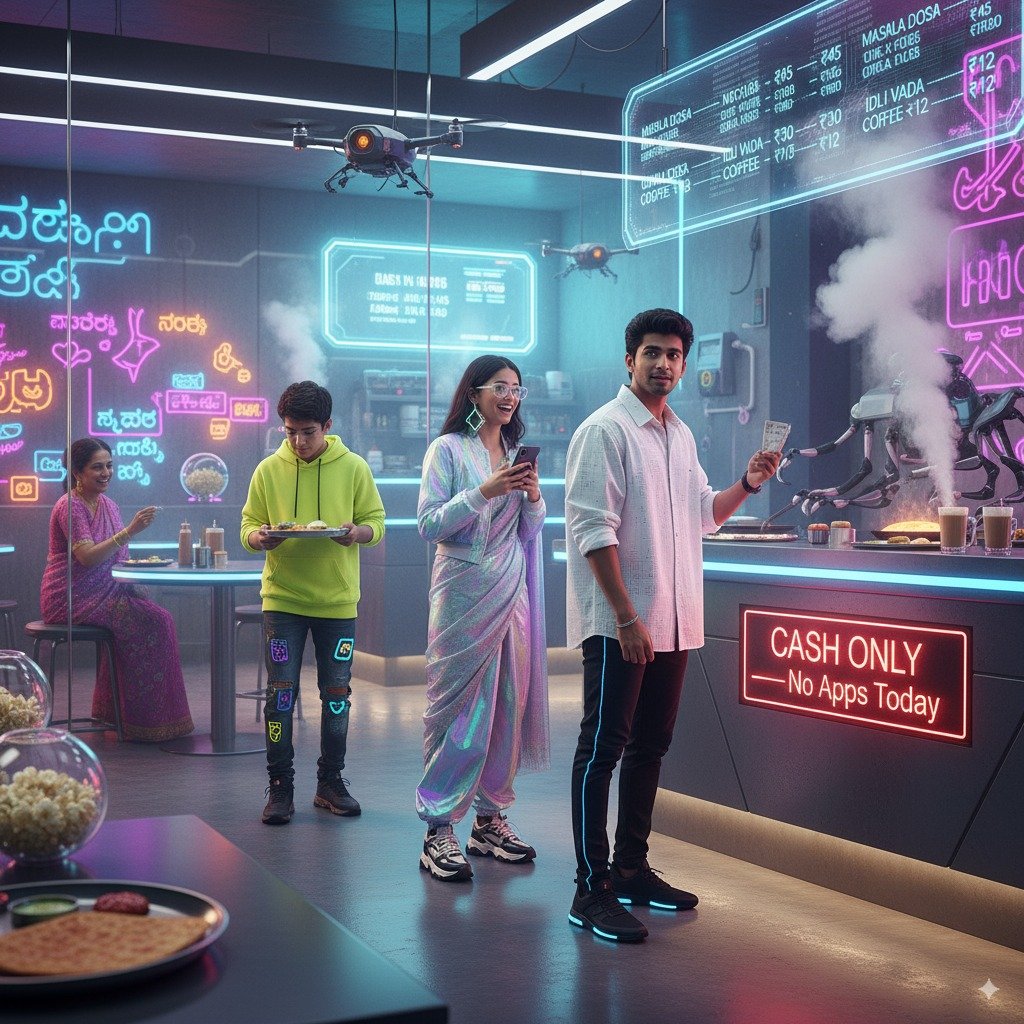 Bengaluru 2075: Cash, chutney, and jasmine.